

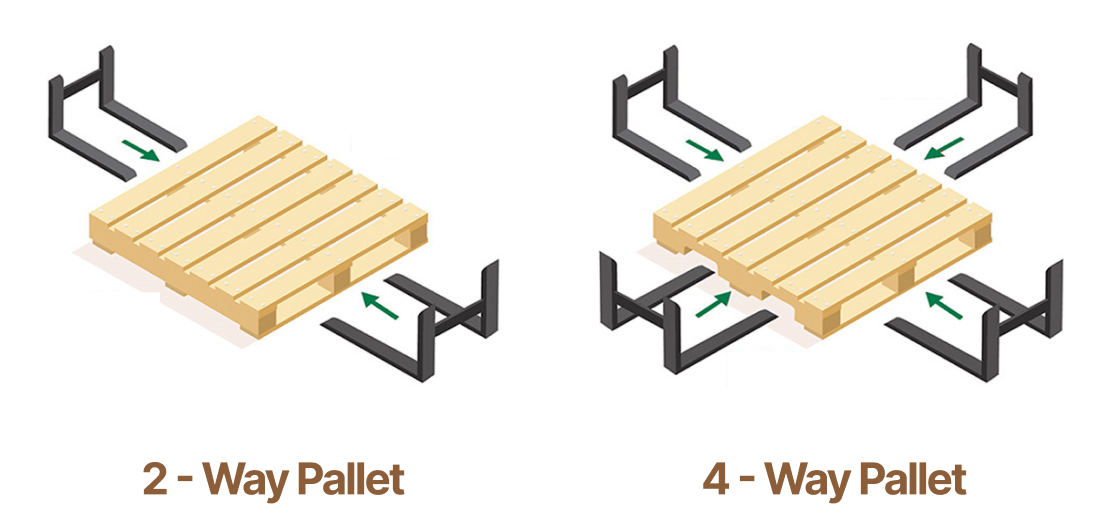
A 4-way pallet allows forklifts to approach it from any side, while a 2-way pallet limits access to just two sides. This flexibility makes the 4-way pallet easier to maneuver, as forklifts or hand trucks can enter from any direction. On the other hand, a 2-way pallet only allows entry from the stringer sides. Block pallets, which use blocks for support instead of stringers, are inherently designed for 4-way access, enabling entry from all sides.
Comparing Block Pallets and Stringer Pallets
To expand on the previous points, it's important to note that a 2-way pallet is a specific kind of stringer pallet. In contrast, a 4-way pallet is built for access from all four sides. Stringer pallets feature long wooden beams (stringers) along their length, allowing access from either two or four sides, depending on whether notches are present. Block pallets, constructed with solid wooden blocks at the corners and center, support the deck and allow access from all four sides, enhancing their usability for handling and storage.
Pallets play a vital role in contemporary logistics, essential for the effective storage, handling, and transportation of goods in warehouses, distribution centers, and supply chains. The main distinction lies in their accessibility for forklifts and pallet jacks. A 2-way pallet restricts access to its longer sides, which can complicate maneuvering in confined spaces. Conversely, a 4-way stringer pallet features notches on the stringers, enabling forklifts or pallet jacks to enter from any direction. This design is typical of the standard 48”x40” GMA pallet, significantly enhancing loading, unloading, and storage efficiency, making 4-way pallets a favored choice in industries focused on streamlined operations and optimal warehouse use.
Frequently Asked Questions About Pallet Types:
What is a four-way entry pallet?
A four-way entry pallet is designed for access from all four sides, enabling forklifts or pallet jacks to lift it from any direction. This is typically achieved through openings or notches on both sides and at the front and back, allowing for versatile handling and storage.
What is a 2-way pallet?
A 2-way pallet is a type of wooden stringer pallet supported by long wooden beams (stringers) that run parallel to its length. It has openings on only two opposite sides for access, allowing forklifts or handling equipment to enter from the two stringer sides.
What is a 4-way GMA pallet?
A 4-way GMA pallet meets the specifications set by the Grocery Manufacturers Association (now known as the Consumer Brands Association) regarding size and construction. It is designed for access from all four sides, promoting efficient handling and transportation within the supply chain, particularly in grocery and retail sectors.
What is a four-way pallet jack?
A 4-way pallet jack is specifically designed to handle 4-way entry pallets from all directions, allowing operators to maneuver pallets efficiently. This design maximizes warehouse space and optimizes load density in trailers by enabling more flexible handling.
Is a 4-way pallet the same as a block pallet?
No, a 4-way pallet is not necessarily the same as a block pallet. While block pallets are primarily 4-way pallets, there are also 4-way stringer pallets that allow access from all four sides. Block pallets typically offer additional structural support and are preferred for heavier loads or specialized applications.
What are the advantages of a 4-way pallet over a 2-way pallet?
The advantages of a 4-way pallet compared to a 2-way pallet include:
- Accessibility: A 4-way pallet allows forklifts or pallet jacks to enter from all sides, simplifying handling and maneuvering in warehouses or during transport.
- Flexibility: With four-way access, loading and unloading can be performed more quickly and efficiently, reducing turnaround times.
- Space Utilization: Four-way entry enables denser storage and stacking of pallets, optimizing warehouse space.
- Reduced Damage: Easier access minimizes the risk of pallet damage during handling, leading to cost savings and better inventory management.
In summary, 4-way pallets offer greater versatility and efficiency in handling and storage compared to 2-way pallets, making them a preferred choice in various logistical and industrial settings.